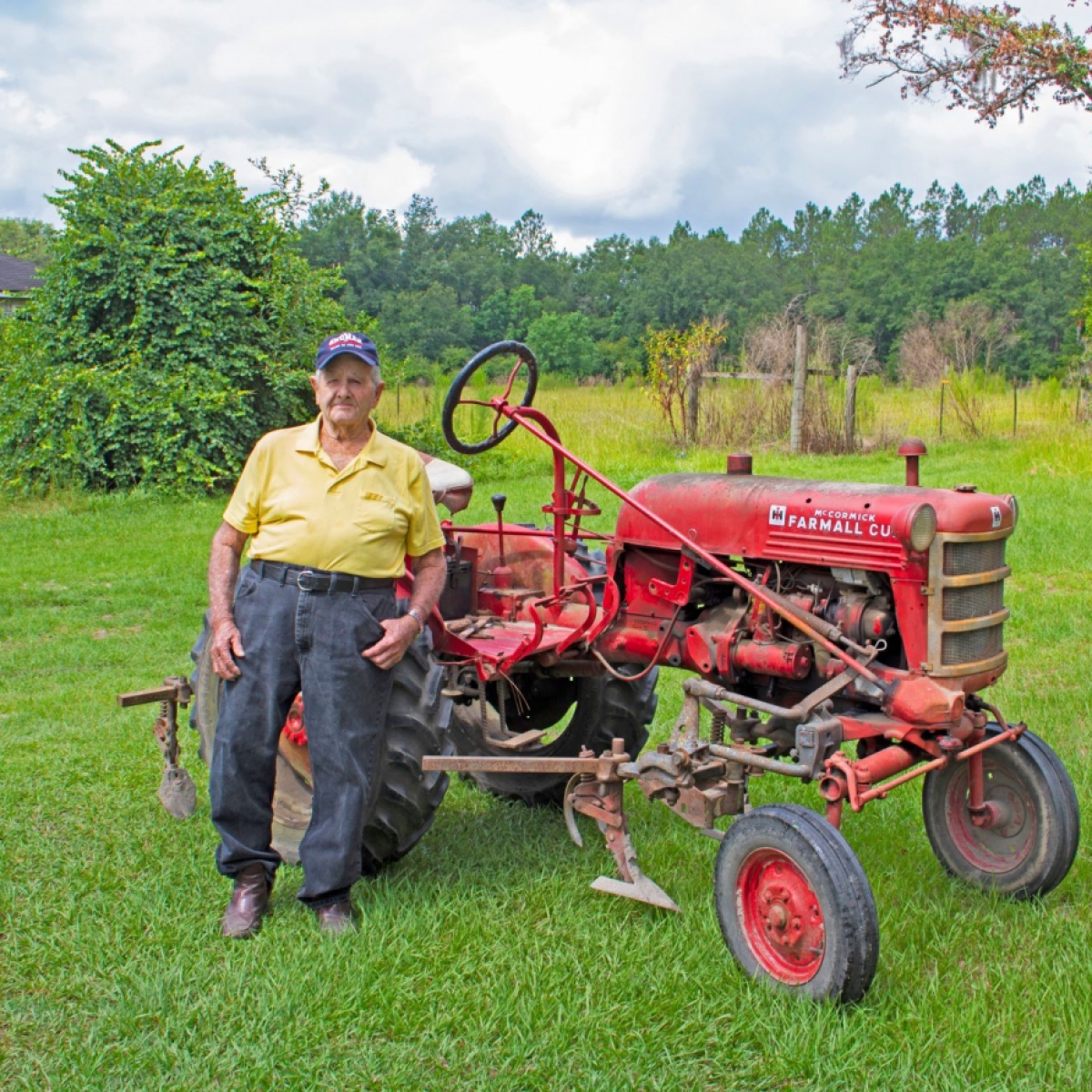
Alvin Shuman: The Marksman, Member and a Man to Remember
His hat says it all . . . Shuman an American Original made in the U.S.A. He is a member of the Greatest Generation—a native of Hoboken who grew up without electricity, plowed fields with a mule, fought on the front lines of WWII, has gone hungry, been tired and suffered in the cold. These hardships shaped the man he became, happiest in his garden or splitting wood so he can help make sure others are “happy and warm.”
Today is Alvin Shuman’s 95th birthday and he recently reflected on the evolution of his life and times, much of which paralleled the growth of Okefenoke REMC.
Born July 16, 1924, Mr. Shuman, or Poppy to his family, grew up working his father’s land, splitting wood for the fire, fetching water and hunting food for dinner. There wasn’t any electricity and plowing the fields meant walking behind a “hard headed mule.” From a very young age he was shooting a .22 caliber rifle. “My daddy gave me five bullets and told me to bring back five squirrels. So, I did,” recalls Mr. Shuman.
His shooting accuracy quickly brought him attention during basic training at Fort Knox, Kentucky. Drafted in 1943 at age 19 he was able to hit the bullseye in eight out of nine rapid-fire shots from 500 yards away. He and one other man in the 1,100 member platoon were ranked Expert Marksman and presented Sharpshooter Awards.
After 17 weeks of basic training he and his platoon were shipped (14 days at sea) off to Frome, England by way of Scotland to continue training. That’s where he became a gunner in a tank and was called up to be a member of the 741st Tank Battalion B Company and part of the D-Day invasion that landed on Omaha Beach on June 6, 1944. While he was glad to get out of training and “marching and hiking up all those hills,” his head bows, and his voice drops as he remembers that fateful day.
“I remember all those boys dying,” he says quietly. “The Germans were in fortifications and just cut’em down like they were cutting bushes. They just cut’em down with machine guns. There would be a wave of them coming toward the beach and sometimes not a one of them made it. We were dropped 6,000 yards from shore and the tanks had inflatable canvas, but the [English] Channel was so rough most of them sunk. There was no air support on the beach and the Germans had better guns and tanks than us.”
Mr. Shuman spent the next year fighting his way across Europe through France, Belgium, Luxembourg, Berlin, Germany, and into what was then Czechoslovakia. There would be days he would go without food and says it would get so cold that there would be frost inside the tank. They were making their way to Prague when they were stopped in Pizeň, or Pilsen, and told the war was over. He spent his 21st birthday in Paris on a leave pass.
After the war Mr. Shuman returned home to a quieter life and worked for his father. Back on American soil he found two things he didn’t have before: God and his “million-dollar baby.” He says he can remember being out with the boys, looking for girls, when they stopped to listen to someone praying. “That’s when I realized I was lost,” notes Mr. Shuman. From then on, he regularly attended Pleasant Valley Church.
While he was no longer “looking for girls” he found the love of his life, Elizabeth—aka his million-dollar baby—at Kress 5 & Dime in Waycross. She was the daughter of a police sergeant and lived in the city. He declared he was going to marry her at first sight. They got to know one another over the next few months and four days after her 16th birthday they were married.
She went from living with all the comforts of city life, to a home in the woods without electricity in the vicinity of what is today Fort Mudge Rd. Mr. Shuman chuckles at the memory of her the morning after they moved in, “She had the bag of grits in one hand and a pot in the other hand and asked how to make them. I said, ‘Let’s go to mama’s.’”
A year later (1948) they moved into the home he still lives in after 71 years. Like many homes in the area, the house was wired for electricity, but OREMC had not yet built the lines to power them because the war curtailed expansion of rural electrification. Given the lack of manpower and materials due to the war effort, OREMC’s growth stalled and no annual meetings were held in 1943, 1944 and 1945. Even after the war, transformers and copper wire were hard to find. While an exact date for when the lights came on in the Shuman household is unknown, it was likely in 1949 and Mr. Shuman recalls that his first electric bill from OREMC was $10. In August of 1950 he was one of several members who made application for appliance and installation loans, most likely for a refrigerator and washing machine. By May of 1952 the Shumans installed an electric range and water heater.
As life progressed and their family grew, so too did Mr. Shuman’s involvement in the church. He was a charter member of Mt. Calvary Baptist Church and involved in the founding of Oak Hill Baptist Church. He says building those churches was one of the best things, aside from marrying Elizabeth, that happened to him.
Mr. Shuman had many different jobs over the years—surveyor with St. Regis Paper Company, school bus driver for Brantley County, logging—but it was working the land that brought him the greatest joy, and still does to this day. Just last year he cut 11 pick up loads of fire wood and gave it all away. Two years ago, he was gifting Megatron cabbages to his neighbors, each weighing about 25 pounds each. He grew 408 of them. This year he planted peas, butter beans, cucumbers and okra.
He says, “I don’t think about living or dying, I just think about getting out there and doing something.” His family is worried that one day they might find him laid out in his garden. His response, “If I go in the garden, I’ll go with a smile on my face.”